


Overview

Voice is no longer just a means of communication: it has become a reflex for searching, comparing and deciding. Smartphones, smartwatches and smart speakers have transformed our daily habits: in Switzerland, people now talk more often to their phone than type on their keyboard.

This evolution is not anecdotal. Already 37% of Swiss people use voice search[1] to find information, plan a purchase, or interact with a brand. A trend that is profoundly redefining the way your customers discover your products and services. 


Why is this crucial for you as a decision-maker or business leader? Because a voice query often leads to a single audible answer. Being that answer means capturing your audience’s immediate attention, guiding their purchase decision and gaining an edge over your competitors. 

Adoption of Voice Search in Switzerland

Adoption Rate and Preferred Devices


Voice search occurs across several device families:


  • Smartphones: still the most used, thanks to built-in voice assistants (Siri, Google Assistant).
  • Smart speakers, like Google Home, Amazon Echo, or Apple HomePod, now household companions.
  • Smartwatches and wearables: Apple Watch, Galaxy Watch and other wearables facilitating quick queries.
  • In-car systems: CarPlay, Android Auto, or automakers’ built-in assistants, used for navigation and hands-free commands.
  • Smart home appliances: connected TVs, refrigerators, or home automation devices that are increasingly integrating voice control.


In 2025, the Swiss smart speaker market is significant (around USD 69.27 million, with an annual growth rate of 8.5% according to industry reports) [2]. This figure shows Swiss households’ commitment to these domestic technologies.


The global market is expected to grow from USD 14.56 billion in 2024 to USD 19.14 billion in 2025, with a CAGR of 31.5% [3].


Concretely, the smartphone remains dominant for mobile searches (directions, schedules, quick recipes), while the smart speaker is gaining ground in domestic use (weather, music, home automation commands and increasingly, informative searches).


Regional and Linguistic Differences


Switzerland is not a homogeneous market: Romandy, German-speaking Switzerland and Ticino show different usage patterns—not only due to language but also because of preferred technological ecosystems (e.g., preference for iOS vs Android or faster adoption of certain compatible assistants in some regions).


A voice strategy in Switzerland must therefore be multilingual and local: the same translated content is not enough; formulations need to be adapted for each linguistic audience.

Impact on Consumer Behavior

What does the Swiss search for with Voice? 


The most frequent uses remain practical: weather, itineraries, calling a contact, or “where to find” queries (nearby store, restaurant). 


But we also observe a shift toward transactional uses: product availability inquiries, specific opening hours and even purchases guided by voice assistants. Studies show that in Switzerland, voice search is widely used for quick and local tasks, giving a huge advantage to businesses with optimized local presence. 


Queries Are Becoming Conversational 


What's the big difference between text and voice? Form


Voice queries are more detailed, often formulated as natural questions: “Where is a bakery open near me?” and “How to reach a plumber tonight?” 


A study, “Smart Product 2025: Swiss Adoption Trends & Insights” indicates that more than 72% of active users in Switzerland use voice commands (Voice search) in their daily technology usage. 


Implications for Marketing and SEO

Think Conversational: Keywords and Content Structure 

Voice SEO is not the same as text SEO. We move from fragmented keywords to full sentences and questions. Instead of optimizing for “plumber Geneva”, think “Where can I find an emergency plumber in Geneva tonight?” 


Integrate well-structured FAQ pages, clear headings (Hn), and concise answers of 30–60 words at the beginning of paragraphs. This is often the response length an assistant will read aloud. 


Structured Data (Schema.org) for Better Voice Visibility

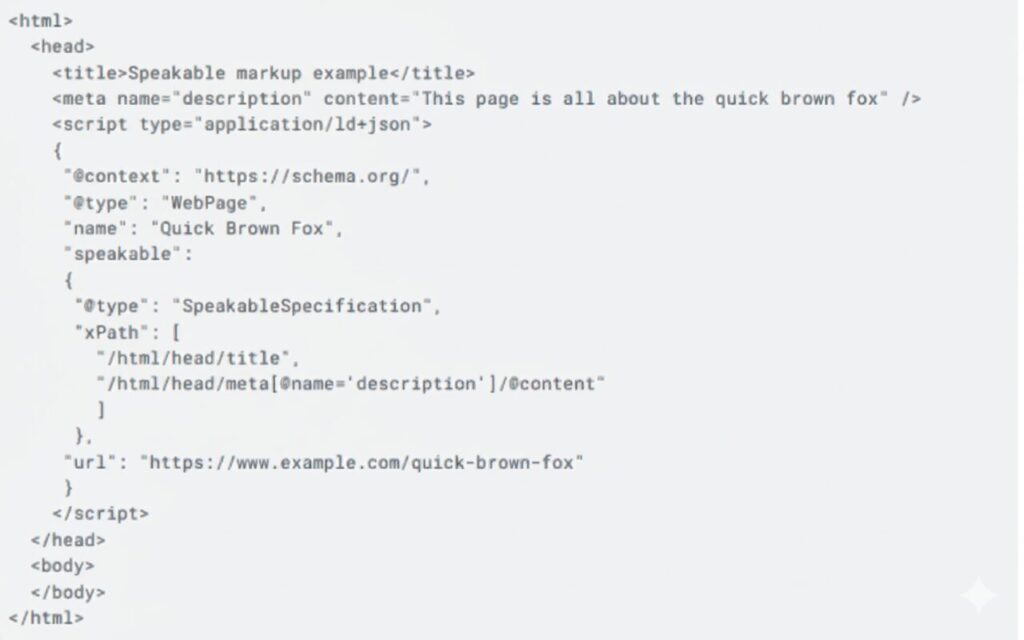
Assistants and search engines rely on structured signals to extract direct answers. Using structured data (Schema.org) and particularly the speakable property (to indicate which parts of an article are suitable for voice reading) helps assistants like Google Assistant select and read your content. Implementing these tags has become essential to increase your chances of being the spoken answer. 


Local SEO: Capturing “Near Me – Closest – Open Now” Intent 

Voice and local queries are natural allies. Many voice searches express strong local intent: finding a shop, service, or restaurant. 


Optimize your Google Business Profile, add local FAQ scripts and use LocalBusiness schema tags to increase your chances of appearing as the immediate answer. 


In Switzerland, where nearly half of searches have high local intent, this is a lever to prioritize.


Opportunities for Swiss Brands

Mobile-First and Voice-Friendly 

When it comes to voice search, user experience is even more demanding than in classic search. Why? Because with voice, people expect an instant and smooth answer


If your site is slow or poorly optimized, the voice assistant may: 


1. Site Speed: A Key Factor 

A page that takes more than 3 seconds to load loses over 50% of mobile users

With voice search, this is even more critical: no one will wait 5 seconds after asking, “Where is the nearest pharmacy?” 


Result: your content, even if relevant, will be ignored in favor of a faster competitor. 


2. Mobile-Friendly Above All 

In Switzerland (as everywhere), most voice queries are made via smartphone. 


responsive site (adapted to all screens) is therefore non-negotiable. 

The design must be clear, readable, with suitable fonts and easy-to-click buttons. 


3. Core Web Vitals: Your Performance Indicators 

Google has defined three essential criteria for evaluating a page’s quality: 


  • LCP (Largest Contentful Paint): the time it takes for the main page element to appear (should be < 2.5s). 
  • FID (First Input Delay): how quickly a user can interact (should be < 100 ms). 
  • CLS (Cumulative Layout Shift): visual stability (avoid elements shifting during load). 
  • Optimizing these indicators ensures a smooth experience, ideal for voice search. 


4. Clear, Visible Answers at the Top of the Page 

Voice assistants seek concise answers (30–60 words max). 


If your content directly answers a frequent question at the top of the page (“What are the opening hours of pharmacy X in Geneva?”), you increase your chances of being chosen as the spoken answer. 


Think FAQ sections or featured snippets


Integrating Assistants into Customer Journeys 


Think of assistants as service channels: voice FAQs, voice-activated orders, or booking via assistant. 


An SME can start by creating voice-optimized FAQ scripts and testing their performance (voice citation rate, voice → call conversions). 

The idea: turn a voice response into a useful interaction—call, direction, purchase. 


Smart Multilingual Strategy 


Do not limit yourself to literal translation. Adapt tone and formulations by language: the question “Where is the best raclette?” is not asked the same way in French, German, or Italian. Test and measure voice impressions by linguistic region. 


Best Practices & Actionable Checklist

Quick checklist to get started (priorities): 


1-Create structured FAQ pages with natural questions (Q/A format). 


2-Implement Schema.org for readable sections, using LocalBusiness, FAQ, and Product types, as well as the speakable format. 


3-Optimize snippets: short answers (30–60 words) at the beginning of sections. 


4-Work on long-tail keywords and conversational formulations in your content. 


5-Enhance your Google Business Profile (hours, photos, local posts). 


6-Test your pages via assistants (Google Assistant, Siri, Alexa). 


7-Monitor Search Console for impressions on conversational queries (zero-click). 


    Conclusion

    Voice search is not a passing trend; it is a transformation of user interfaces


    In Switzerland in 2025, with a significant share of voice users and a booming smart speaker market, brands that adapt their content (conversational, structured, local, and multilingual) will gain a tangible advantage. 


    You don’t need to change everything overnight: start with voice FAQs, the speakable schema, and local optimization


    Eminence can support you in defining and implementing a voice-first strategy tailored to the Swiss market. Contact us to benefit from our expertise. 


    Contact us for more information.
    Arafet
    Written by
    SEO & GEO Consultant

    SEO and acquisition expert Arafet improves visibility and conversion with a strategic, technical approach that delivers real results.

    These topics might interest you
    Swiss E-Commerce Growth: Why Is the Market Changing So Fast?
    With 15.8 billion CHF in 2025, Swiss e-commerce proves its maturity. However, growth is shifting: the race for market share is giving way to loyalty and operational excellence.
    AI visibility in financial services: Who AI trusts in 2026
    AI is now a primary source for financial advice, but its "hierarchy of trust" is deeply divided. From the dominance of giants like Fidelity to the surprising influence of Reddit on ChatGPT, this article breaks down how AI platforms source data in 2026 and how brands can build a dual-approach visibility playbook to win.
    International Brand Strategies: Standardization, Scale, and Global SEO
    The digital revolution has transformed how customers discover, select, and remain loyal to their favorite brands. Today, being listed on Google is no longer enough: it is essential to appear at the right time, in the right place, and to position yourself as a credible and attractive player in a competitive market.